






Technology Keeps Logistics on the Move
The ICT team develops KWH Logistics’ systems to meet the needs of the business and make work easier, more efficient and safer.
“ICT is our strategic backbone; it facilitates both growth and smooth day-to-day operations,” says Vesa Peltola, Director of ICT and Digitalisation at KWH Logistics.
“When the systems support operations seamlessly and integrate into our customers’ systems, the prerequisites for business emerge: we can consistently deliver good customer service and do things more efficiently across the Group.”
The ICT team at KWH Logistics often works behind the scenes, but their impact is everywhere. When systems work, information flows and customers receive their services on time, it’s the result of the deliberate work of a number of experts.

“We make sure that everything works, and if it doesn’t, it will work again soon,” says systems expert Aki Räsänen with a laugh.
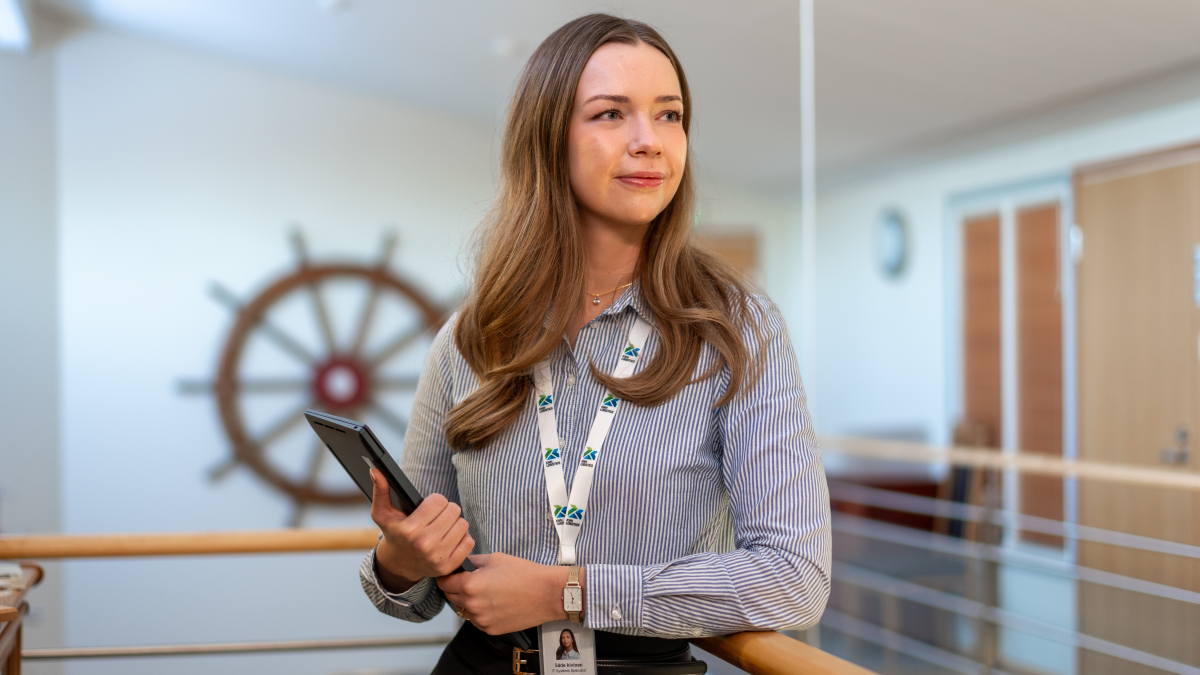
His and his colleague Säde Kivinen’s job description includes the development and maintenance of KWH Logistics’ systems: software customisation, integrations, security, user and development support and liaison with the Group’s various business units.
Development work at the heart of day-to-day life
In practice, the ICT team acts as an internal service unit for the entire Group. It supports and develops systems used in ports, warehouses, freight forwarding and heavy equipment services.
“We implement solutions to meet the needs of different companies and ensure that they work seamlessly together. Previously, different companies had lots of custom solutions, but now the trend is towards more unified systems that facilitate collaboration and data management within the Group,” Kivinen says.
The work is practical and constantly evolving.
“We are continuously learning new things and thinking about how to do things better, easier and clearer for both ourselves and our customers,” says Räsänen.
Practical solutions and benefits
The contribution of ICT is reflected in many concrete improvements. For example, a graphical user interface for handling sawn timber was developed for Rauanheimo.
“It gives the customer a real-time view of the port’s warehouse situation, goods flows and locations. In practice, we act as an extension of their own warehouse. The solution increases efficiency and reliability,” Räsänen says.
Another successful project was the development of a scanning system that automatically updates the location and status of products.
“The right products are in the right place at the right time. Sounds simple, but it’s crucial for efficient logistics,” says Kivinen.
Cooperation yields the best outcome

Both Räsänen and Kivinen emphasise the close link to the day-to-day running of businesses. Räsänen works at the Vuosaari terminal, where ideas and feedback flow quickly.
“When you are close to operations, insights and new ideas emerge quickly. It’s rewarding to be able to experiment and develop together,” he says.
Kivinen works in Kokkola, but she stresses the same point:
“There is a constant discussion. When we understand how the business works in practice, we know how to do the right things right. That’s what cooperation is about in the end.”
Looking ahead
Digitalisation, automation and artificial intelligence are rapidly shaping day-to-day logistics. The ICT team sees change as an opportunity.
“It’s interesting how AI can be used to genuinely support processes in, for example, the planning, reporting and forecasting of goods flows. We have already taken steps in this direction,” says Räsänen.
According to Kivinen, the role of ICT is growing all the time.
“Our job is to make sure that work is easier, more efficient and safer. The future demands it, and we are ready to evolve with it.”
Read more goodstories articles